
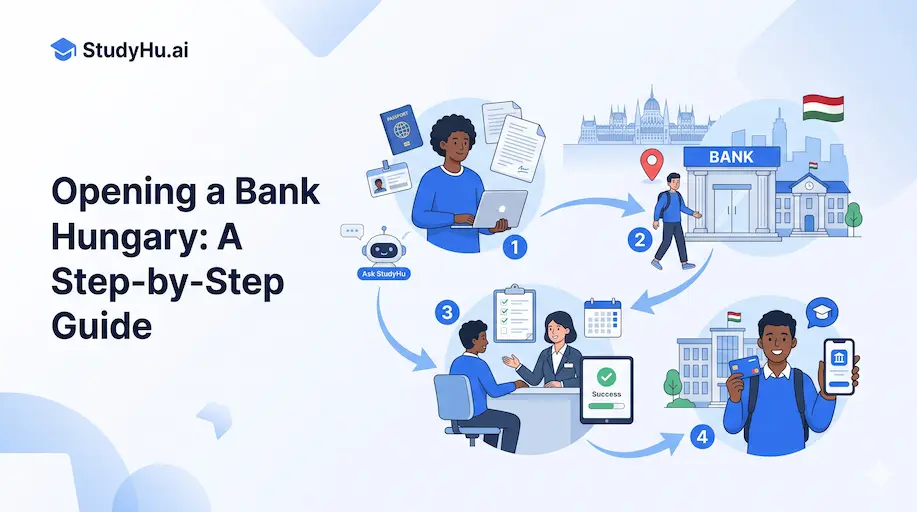
While banks are private businesses and can technically choose who to accept as a client, following this guide will make the application process as smooth as possible.-
Overview
- What it is: A local Hungarian bank account is a secure, personal financial account used to store, manage, and transfer Hungarian Forints (HUF) and other currencies.
- Why it is important: If you are studying in Hungary on a governmental scholarship (such as the Stipendium Hungaricum), opening a local bank account is mandatory so your monthly allowance can be transferred to you. It is also useful for everyday expenses and handling your finances smoothly.
- Who needs it: Any international student studying in Hungary (including Stipendium Hungaricum, Erasmus, self-funded, exchange, and newly admitted students). While it is strictly mandatory for scholarship students, it is highly recommended for all.
Step-by-Step Guide
Step 1: Gather Your Documents
Collect your basic identification documents and university papers before heading out. If you are a citizen of a high-risk (FATF-listed) country, you must collect a more extensive list of records and arrange for in-person support. list of all banks that operate in Hungary.
- What to prepare: Valid passport, a second ID, and your official university enrollment certificate. High-risk applicants also need their residence permit, address card, scholarship award and acceptance letters, rental contract, two Hungarian witnesses, and a Hungarian translator.
- Tips: You can often request translator assistance from your university’s international student mentor team.
- Common mistakes: Forgetting a second ID or turning up without the extra required paperwork if you are from a high-risk region.
Step 2: Choose Your Bank
Select a banking provider that fits your needs as an international student.
- What to prepare: Research which bank has the best accessibility for you.
- Tips: Most international students choose OTP, MBH, or Erste because they have a large international client base and fully functional English mobile apps.
- Common mistakes: Picking a bank that does not offer a English-language mobile application, which makes managing your money day-to-day much harder.
Step 3: Visit the Branch & Apply
Go to a physical branch of your chosen bank to submit your paperwork and fill out forms.
- What to prepare: Bring all your gathered documents and your translator/mentor if needed. Make sure to check the opening hours.
- Tips: Standard bank opening hours are weekdays from 8:00 AM to 4:00 PM. They are closed on Saturdays, except for select branches located inside major shopping malls (such as Allee Mall). If you are from a high-risk country, go to one of the proven branches in Budapest listed in the “Official Resources” section below.
- Common mistakes: Giving up if a bank rejects your request on the first try. If a bank rejects you, keep trying at different branches. There are documented cases where students successfully opened their account on their 12th attempt!
Step 4: Wait for Approval
The bank reviews your application profile against security and financial regulations.
- What to prepare: No action is needed from you during this step; simply monitor your phone or email.
- Tips: Standard accounts are usually opened on the spot.
- Common mistakes: Not planning your budget ahead of time if you are a high-risk applicant, as your approval process takes significantly longer.
Required Documents
For a standard application, you must bring the following documents. However, please note that banks are private businesses and can technically choose who to accept as a client.
| Document | Why it is needed | Where to get it | Important Notes |
| Valid Passport | Core proof of identity and international legal status. | Your home country’s government / passport agency. | Must be valid and not expired. |
| A Second ID | Secondary identity verification required by banks. | Your home country’s government or tax authority. | Can be a driver’s license, tax card, or national identity card. |
| School Attendance Certificate | Proves your official student status certificate in Hungary. | Your host Hungarian university. | Must be an official enrollment certificate. |
Additional Documents for High-Risk Countries (FATF List)
Due to strict EU anti-money laundering regulations, Hungarian banks must perform intense due diligence on citizens from countries on the Financial Action Task Force (FATF) list. Students from Iran, Syria, Iraq, and Jordan frequently face obstacles. If you are from one of these regions, you must also bring:
- Residence Permit & Address Card: Issued by the Hungarian immigration authority. (Note: A residence permit is not strictly required for standard openings, though citizens of certain countries may be exceptions).
- Scholarship Letter of Award & Letter of Acceptance: Issued by your scholarship provider and host university.
- Rental Contract / Accommodation Agreement: Provided by your landlord or dormitory.
- Two Hungarian Witnesses: Required to sign your paperwork in person at the bank branch in some cases.
- A Hungarian Translator: Crucial for navigating complex forms.
Fees
- Official fee: not fixed baseline opening fee for standard accounts.
- Payment methods: N/A
- Possible additional costs:
- Monthly Maintenance Fees: Banks charge a regular fee to keep your account open. These continue to accumulate into debt if you leave the country without closing the account.
- ATM Commissions: Hungarian banks charge a fee for ATM usage. This service fee is significantly higher if you use an ATM owned by a bank different from your card provider.
- Private ATM Conversion Fees: Independent, standalone private ATMs in the city center (such as Euronet) charge massive, predatory conversion fees when a foreign card is detected.
Processing Time
- Average waiting time: Standard accounts are usually opened on the spot. For applicants from high-risk countries, it usually takes up to two weeks (14 days) for an official decision.
- Busy seasons: This information is not available in the provided sources.
- Expedited options: This information is not available in the provided sources.
Important Tips
Close Your Account Before Leaving Hungary!
When you graduate and prepare to leave the country, you must close your bank account in person (especially if you are using OTP). If you forget, the bank will continue charging monthly maintenance fees, leading to accumulated debt. Banks generally do not allow you to close accounts from abroad unless you go through a highly complex, expensive legal authorization process.
- Use FinTech Alternatives Alongside Your Account: Many international students use multi-currency virtual accounts (like Revolut or Wise) alongside their local Hungarian bank account to handle easy international transfers and cheap currency exchange.
- No Need to Exchange Cash Before Arrival: You do not need to carry large amounts of physical cash or exchange Hungarian Forints (HUF) before arriving. ATMs are widely available across Budapest and easily accept Visa and MasterCard.
- SZÉP Cards for Working Students: If you get a job or internship, your employer might offer you a “SZÉP card” as a tax-free cafeteria benefit. You can open a SZÉP account at K&H, MBH, or OTP Bank, but you must bring a Hungarian witness with you to your physical bank appointment to successfully open it.
Common Mistakes
- Using Private ATMs in the City Center: Using standalone, independent private ATMs (like Euronet) will result in massive, predatory currency conversion fees when a foreign card is detected. Stick to official bank-owned ATMs.
- Using a Different Bank’s ATM: Withdrawing cash from an ATM that belongs to a bank different from your card provider results in a significantly higher service fee.
- Going to the Bank Empty-Handed (High-Risk Applicants): Going without the extended checklist of documents, a translator, or witnesses if you are from an FATF-listed country will result in immediate delays or rejection.
- Leaving Hungary Without Closing the Account: Assuming the account will close automatically after graduation is a huge mistake. It will accumulate monthly maintenance debt that is incredibly difficult to resolve from abroad.
Frequently Asked Questions (FAQ)
Q: Is it mandatory for all international students to open a Hungarian bank account?
A: It is strictly mandatory if you are studying on a governmental scholarship (such as Stipendium Hungaricum) so your monthly allowance can be transferred to you. For self-funded or Erasmus students, it is highly recommended but standard banks technically choose who to accept as a client.
Q: Do I need a residence permit to open a standard bank account?
A: In most cases, a residence permit is not strictly required for standard openings, though citizens of certain countries may be exceptions.
Q: Why does it take longer for students from Iran, Syria, Iraq, or Jordan to open an account?
A: Due to strict EU anti-money laundering regulations, Hungarian banks must perform intense due diligence on citizens from countries on the FATF list. Applications for these high-risk profiles usually take up to two weeks for an official decision.
Q: Can I open a bank account on the weekend?
A: Standard bank branches are closed on Saturdays and Sundays. However, select branches located inside major shopping malls, such as Allee Mall, are open on Saturdays.
Q: What should I do if a bank rejects my application?
A: Do not give up. Keep trying at different branches. There are documented cases where international students successfully opened their account on their 12th attempt.
Q: Can I close my Hungarian bank account online after I return home?
A: No. You must close your bank account in person before leaving Hungary. Banks generally do not allow you to close accounts from abroad unless you go through a highly complex and expensive legal authorization process.
Q: What is a SZÉP card and how do I open an account for it?
A: It is a tax-free cafeteria benefit offered by some employers for working students or interns. You can open one at K&H, MBH, or OTP Bank, but you must bring a Hungarian witness with you to your physical appointment.
Official Resources
Proven Bank Branches for High-Risk Applications
If you are facing obstacles due to FATF-list regulations, these specific Budapest locations have successfully processed international student accounts:
- OTP Bank (Astoria): 1075 Budapest, Károly körút 1.
- OTP Bank (Deák Ferenc tér): 1052 Budapest, Deák Ferenc utca 7-9.
- OTP Bank (Allee Mall): 1117 Budapest, Október huszonharmadika utca 8-10.
- OTP Bank (Near Rákóczi tér): 1085 Budapest, József körút 33.
- Erste Bank (Allee Mall): 1117 Budapest, Október huszonharmadika utca 8-10.
- Erste Bank (Near Oktogon): 1066 Budapest, Teréz körút 24.
Source References
- Money Laundering (AML) For more information about the countries with weak anti-money laundering or terrorist financing regimes check the FATF list here.

Leave a Reply